Federation - When One Graph Isn't Enough (A Tale of Microservices)
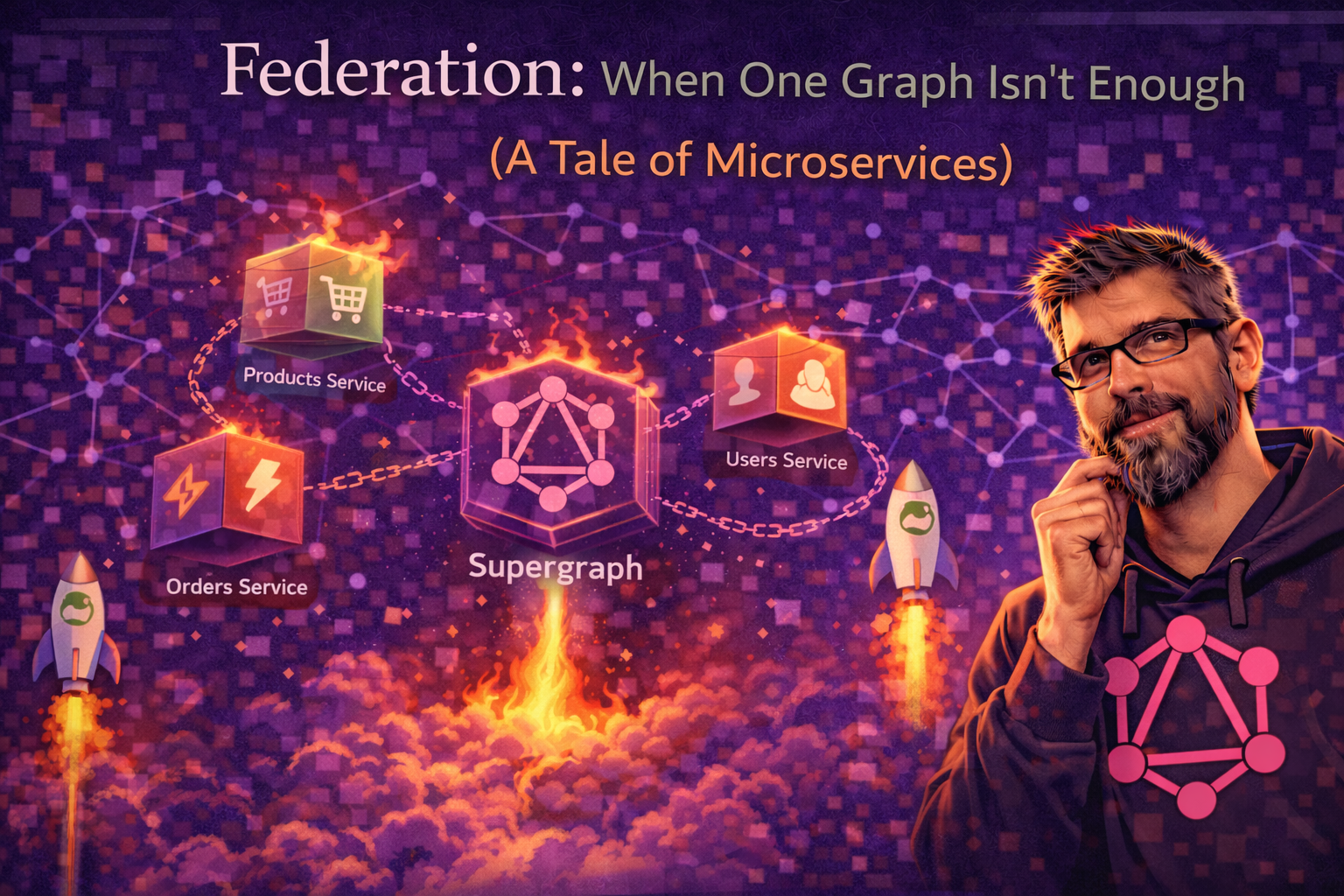
You've heard the promise: "One graph to rule them all." But your organization has 47 microservices, 12 teams, and zero patience for a monolithic schema. Enter Federation - GraphQL's answer to "it's complicated."
The Monolith Problem
Picture this: You're at BigCorp Inc. Your GraphQL API started beautifully:
type Query {
  user(id: ID!): User
  product(id: ID!): Product
  order(id: ID!): Order
}
Three types. One team. Life was good.
Fast-forward two years:
type Query {
  # User team
  user(id: ID!): User
  users(filter: UserFilter): [User!]!
  currentUser: User

  # Product team
  product(id: ID!): Product
  products(filter: ProductFilter): [Product!]!
  productsByCategory(category: String!): [Product!]!
  searchProducts(query: String!): [Product!]!

  # Orders team
  order(id: ID!): Order
  orders(userId: ID!): [Order!]!
  ordersByStatus(status: OrderStatus!): [Order!]!

  # Inventory team
  inventory(productId: ID!): Inventory
  lowStockProducts: [Product!]!

  # Reviews team
  reviews(productId: ID!): [Review!]!
  userReviews(userId: ID!): [Review!]!

  # ... 50 more query fields
}
The schema file is 3,000 lines. Merge conflicts happen daily. The "GraphQL team" has become a bottleneck. Teams are angry. Developers are leaving. The CTO wants answers.
The Federation Promise
Federation lets each team own their slice of the graph:
┌─────────────────────────────────────────────────────────────────────┐
│                    FEDERATED ARCHITECTURE                            │
├─────────────────────────────────────────────────────────────────────┤
│                                                                     │
│                        ┌─────────────┐                              │
│                        │   Gateway   │                              │
│                        │  (Router)   │                              │
│                        └──────┬──────┘                              │
│                               │                                     │
│        ┌──────────────────────┼──────────────────────┐              │
│        │                      │                      │              │
│   ┌────▼────┐           ┌────▼────┐           ┌────▼────┐          │
│   │  Users  │           │Products │           │ Orders  │          │
│   │ Service │           │ Service │           │ Service │          │
│   └─────────┘           └─────────┘           └─────────┘          │
│    Team A                Team B                Team C               │
│                                                                     │
│   Each service:                                                     │
│   - Owns its types                                                  │
│   - Extends shared types                                            │
│   - Deploys independently                                           │
│                                                                     │
└─────────────────────────────────────────────────────────────────────┘
Federation Concepts
Concept 1: Entity Types
An entity is a type that can be referenced across services. It has a key:
# Users Service
type User @key(fields: "id") {
  id: ID!
  name: String!
  email: String!
}
The @key directive says: "This type can be looked up by id from any service."
Concept 2: Extending Types
Other services can extend entities:
# Orders Service
extend type User @key(fields: "id") {
  id: ID! @external
  orders: [Order!]!
}

type Order @key(fields: "id") {
  id: ID!
  user: User!
  total: Money!
}
The Orders Service doesn't know how to fetch a user's name - but it can add orders to the User type.
Concept 3: The Gateway
A gateway (Apollo Router, Netflix DGS, etc.) stitches services together:
# Client's view - seamless!
query {
  user(id: "123") {
    name          # From Users Service
    email         # From Users Service
    orders {      # From Orders Service
      total
    }
    reviews {     # From Reviews Service
      rating
    }
  }
}
The client sees one graph. Under the hood, three services collaborate.
Implementing Federation with Spring
Setup: The Users Subgraph
<!-- pom.xml -->
<dependency>
    <groupId>com.apollographql.federation</groupId>
    <artifactId>federation-spring-graphql-starter</artifactId>
    <version>4.0.0</version>
</dependency>
# src/main/resources/graphql/schema.graphqls

type Query {
  user(id: ID!): User
  users: [User!]!
}

type User @key(fields: "id") {
  id: ID!
  name: String!
  email: String!
  createdAt: DateTime!
}
@Controller
public class UserController {

    private final UserRepository userRepository;

    @QueryMapping
    public User user(@Argument String id) {
        return userRepository.findById(id).orElse(null);
    }

    @QueryMapping
    public List<User> users() {
        return userRepository.findAll();
    }
}

// Entity resolver - for federation lookups
@Controller
public class UserEntityController {

    private final UserRepository userRepository;

    @EntityMapping
    public User user(@Argument("id") String id) {
        return userRepository.findById(id).orElse(null);
    }
}
Setup: The Orders Subgraph
# schema.graphqls

type Query {
  order(id: ID!): Order
  ordersByUser(userId: ID!): [Order!]!
}

type Order @key(fields: "id") {
  id: ID!
  userId: ID!
  items: [OrderItem!]!
  total: Money!
  status: OrderStatus!
  createdAt: DateTime!
}

# Extend User from Users Service
extend type User @key(fields: "id") {
  id: ID! @external
  orders: [Order!]!
}

type OrderItem {
  productId: ID!
  quantity: Int!
  price: Money!
}

type Money {
  amount: Float!
  currency: String!
}

enum OrderStatus {
  PENDING
  PAID
  SHIPPED
  DELIVERED
}
@Controller
public class OrderController {

    private final OrderRepository orderRepository;

    @QueryMapping
    public Order order(@Argument String id) {
        return orderRepository.findById(id).orElse(null);
    }

    @QueryMapping
    public List<Order> ordersByUser(@Argument String userId) {
        return orderRepository.findByUserId(userId);
    }

    // Resolve User.orders
    @SchemaMapping(typeName = "User", field = "orders")
    public List<Order> ordersForUser(User user) {
        return orderRepository.findByUserId(user.getId());
    }
}
Setup: The Gateway
Using Apollo Router (Rust-based, high performance):
# router.yaml
supergraph:
  introspection: true
  listen: 0.0.0.0:4000

subgraphs:
  users:
    routing_url: http://users-service:8080/graphql
  products:
    routing_url: http://products-service:8080/graphql
  orders:
    routing_url: http://orders-service:8080/graphql
  reviews:
    routing_url: http://reviews-service:8080/graphql

headers:
  all:
    request:
      - propagate:
          named: authorization
The Query Execution Dance
Let's trace a federated query:
query GetUserWithOrders {
  user(id: "123") {
    name
    email
    orders {
      id
      total
      items {
        productId
      }
    }
  }
}
┌─────────────────────────────────────────────────────────────────────┐
│                    QUERY EXECUTION FLOW                              │
├─────────────────────────────────────────────────────────────────────┤
│                                                                     │
│  1. Client sends query to Gateway                                   │
│                                                                     │
│  2. Gateway creates query plan:                                     │
│     ┌─────────────────────────────────────────────────────┐        │
│     │ Fetch(Users) {                                       │        │
│     │   user(id: "123") { id name email }                  │        │
│     │ }                                                    │        │
│     │   └─▶ Flatten(Orders) {                              │        │
│     │        _entities(representations: [...]) {           │        │
│     │          ... on User { orders { id total items } }   │        │
│     │        }                                             │        │
│     │      }                                               │        │
│     └─────────────────────────────────────────────────────┘        │
│                                                                     │
│  3. Gateway executes plan:                                          │
│     a) Call Users Service: GET user, get {id, name, email}         │
│     b) Call Orders Service: _entities query with user ID           │
│     c) Merge responses                                              │
│                                                                     │
│  4. Return merged response to client                                │
│                                                                     │
└─────────────────────────────────────────────────────────────────────┘
Federation Patterns
Pattern 1: Shared Types
Types that multiple services need to understand:
# Shared schema (published to all services)
type Money @shareable {
  amount: Float!
  currency: Currency!
}

enum Currency {
  USD
  EUR
  GBP
}
Each service can use Money without owning it.
Pattern 2: Computed Fields
Add computed fields to entities you don't own:
# Analytics Service
extend type User @key(fields: "id") {
  id: ID! @external
  # Computed field
  engagementScore: Float! @requires(fields: "id")
}

extend type Product @key(fields: "id") {
  id: ID! @external
  # Computed from analytics data
  popularityRank: Int!
  conversionRate: Float!
}
Pattern 3: The Reference Resolver
When one service needs minimal data from another:
# Orders Service needs product names for display
type OrderItem {
  quantity: Int!
  product: Product!  # Just a reference
}

extend type Product @key(fields: "id") {
  id: ID! @external
  name: String! @external  # Will be resolved by Products Service
}
The Orders Service stores productId. Federation fetches name from Products Service.
Pattern 4: Override
When you need to change a field's resolver:
# Products Service defines base inventory
type Product @key(fields: "id") {
  id: ID!
  name: String!
  inventory: Int!  # Basic count
}

# Inventory Service has real-time data
extend type Product @key(fields: "id") {
  id: ID! @external
  inventory: Int! @override(from: "products")  # Takes over!
}
Federation Challenges
Challenge 1: N+1 in Disguise
query {
  users {           # Users Service: 1 call
    name
    orders {        # Orders Service: N calls? Or batched?
      total
    }
  }
}
Solution: The gateway batches entity lookups:
# Gateway calls Orders Service ONCE with all user IDs
_entities(representations: [
  { __typename: "User", id: "1" },
  { __typename: "User", id: "2" },
  { __typename: "User", id: "3" }
]) {
  ... on User { orders { total } }
}
Make sure your service handles batches efficiently:
@EntityMapping
public List<User> users(@Argument List<Map<String, Object>> representations) {
    List<String> ids = representations.stream()
        .map(rep -> (String) rep.get("id"))
        .toList();

    Map<String, User> usersById = userRepository.findAllById(ids).stream()
        .collect(Collectors.toMap(User::getId, u -> u));

    return ids.stream()
        .map(usersById::get)
        .toList();
}
Challenge 2: Circular Dependencies
# Users Service
type User @key(fields: "id") {
  id: ID!
  favoriteProduct: Product  # Depends on Products
}

# Products Service
type Product @key(fields: "id") {
  id: ID!
  topReviewer: User  # Depends on Users
}
This creates a circular dependency. Solutions:
- Accept it - Federation handles cycles
- Break the cycle - Move one field to a third service
- Use interfaces - Abstract the dependency
Challenge 3: Schema Coordination
Who decides what User looks like when 5 services extend it?
Solution: Schema governance
# .github/workflows/schema-check.yml
name: Schema Check

on: [pull_request]

jobs:
  check:
    runs-on: ubuntu-latest
    steps:
      - uses: actions/checkout@v3

      - name: Rover Schema Check
        env:
          APOLLO_KEY: ${{ secrets.APOLLO_KEY }}
        run: |
          rover subgraph check my-graph@production \
            --schema ./schema.graphqls \
            --name users
Migration Strategy
Phase 1: Identify Boundaries
┌─────────────────────────────────────────────────────────────────────┐
│                 SERVICE BOUNDARY ANALYSIS                            │
├─────────────────────────────────────────────────────────────────────┤
│                                                                     │
│  Current Monolith          →    Potential Services                  │
│  ────────────────────────────────────────────────────────────────   │
│  User types                →    Users Service (Team A)              │
│  Product types             →    Products Service (Team B)           │
│  Order types               →    Orders Service (Team C)             │
│  Review types              →    Reviews Service (Team D)            │
│  Payment types             →    Payments Service (Team E)           │
│                                                                     │
│  Shared types:                                                      │
│  - Money                   →    Shared library / copied             │
│  - Address                 →    Shared library / copied             │
│                                                                     │
└─────────────────────────────────────────────────────────────────────┘
Phase 2: Gateway Introduction
Run federation alongside your monolith:
Client → Gateway → Monolith (all queries)
         └─────→ New Users Service (shadowed)
Compare responses. Ensure compatibility.
Phase 3: Traffic Shifting
Week 1:  Gateway → 100% Monolith
Week 2:  Gateway → 90% Monolith, 10% Users Service
Week 3:  Gateway → 50% Monolith, 50% Users Service
Week 4:  Gateway → 0% Monolith (for users), 100% Users Service
Phase 4: Extract More Services
Repeat for Products, Orders, etc.
When Not to Federate
Federation isn't free. Skip it if:
❌ Small team - Coordination overhead > benefits ❌ Simple schema - < 50 types, why complicate? ❌ Same codebase - Services share a repo anyway ❌ Sync-heavy - Types change together frequently
Use federation when:
✅ Multiple teams - Need independent deployment ✅ Large schema - 100+ types, growing ✅ Different tech stacks - Java, Node, Python services ✅ Different data stores - Each service owns its data
Conclusion
Federation is GraphQL's answer to microservices. It lets teams own their domains while presenting clients with a unified graph.
But it's not magic. It adds complexity: gateways, entity resolvers, schema coordination, debugging across services.
The question isn't "Is federation good?" It's "Do we have the problems federation solves?"
If the answer is yes - if you're fighting merge conflicts daily, if teams are blocked on the GraphQL team, if your schema has become unwieldy - federation is your path to sanity.
If not, enjoy your monolith. There's nothing wrong with a well-designed single service.
This blog post was written by a team of microservices, federated through one author's brain. Query plan available upon request.